2/11/2007

I Love the Pacific Northwest


Left Seattle at 7:30, hiked to Heather Lake, and returned home to Seattle by just after noon. Alfred took the photies.

1/19/2007

Demarest, New Jersey

9:39 pm Eastern/Standard time. 6:39 pm Pacific. 8:40 pm Central. 11:40 am Perth. Hello.

My mom is safe asleep in her new bed, dreaming a dream that is not the nightmare that is all she remembers of cancer. All day she smiled and made jokes with me and with the nurses and physical therapists who care for her now, and all the jokes came out dry and just a little bit sarcastic because she inflects no emotion into anything she says. "I'm back in business," she said as seriously as anyone possibly could have. "I can't wait to see you on Monday," she said to the occupational therapist before she left for the weekend. I knew what she meant -- that she was tired after what was surely the busiest day that she has had in five months. A different therapist every fifteen minutes or half hour; walking; talking with me; eating three meals. Yes, I knew what she meant. There is a look in her eye that I learned to read when I was born. Hers is a body I know like a home. But she is different now. She pulled herself through the nightmare, and has become another incarnation of my mother, the homemaker, the housewife who packed my lunch every single day of my school career from kindergarten through the twelfth grade. She has become an enigma, a beautiful mystery, a person who possesses a strength beyond my wildest imagination.

And yes, I have fiddled with the layout again. The print is Anni Alber's; she and her beau, Josef, were design geniuses. Thank you Anni, and thanks, Chris, for the inspiration and the know-how.

1/16/2007

Whistler, British Columbia


Trains possess an air of romance specific to the spirits of roaming, loneliness and slow, but determined progress that I find so alluring, that I can sympathize so easily with. In Function Junction, twenty minutes outside of Whistler Village, we snowshoed down a well-used track to an old train wreck. Imagine the conductor's suprise when he saw us waving to him from a low snow bank on the left side of the track, just out of his way. Unexpected company for a brief moment of a long journey through Canada's white and green landscape.

12/21/2006

Good Morning


Here they come, our neighbors. Wood ducks, cormorants, mallards, herons, and barrow's mergansers are sleepy, half-pronounced syllables uttered with black ink. The sun brandishes what she has in her candy bag of light, and the sky tastes of ruby, melon, calypso orange, and pearl. Come out, come out! she shouts. Colors, schedules, layouts, and noise beckon our bodies from the susurrus dark. Our voices rise from the bed. The mallards on the dock quack hungrily. Cormorants dive deep. There is no going back now. Day is here and night has starved us for it, all over again.

12/14/2006

Drifting Away on Portage Bay


For heaven's sake my entries have been serious lately. Unfortunately, Lung Cancer isn't anything but serious; however, a houseboat's unmooring does not have to be taken as so. Yes, the other day, the same day I arrived home from my train journey home to Seattle from my visit home to my mama (with the flu), I went out for an errand, and when I returned I noticed that the house's position was all askew. In the windstorm (a record-breaking, history-making windstorm is due this evening, just a few hours from now) several of the ropes that tie our house to the dock were lashed putting us at risk of floating away. It might have been romantic had we run with it and voyaged all the way out to the sound. I would have liked to float beside the whales and the hundred herons I saw from the train. I would have liked to watch them from the couch, wrapped in a blanket sipping from a cuppa hot tea. But I'm glad we're here now, across from the university that I will kayak to in the spring, when the rain stops, although I realize that there is a growing possibility that it will not ever stop. I guess that fantasy of being inside your house while simultaneously being in the middle of the ocean is what spawned the creation of yachts and cruises and I hate those. Anyway, here are some photos of the diver who came to readjust the floats beneath us. I am sorry now that I did not take a picture of the house when it was loose. I admit that at the time I was a bit miffed.

12/13/2006

The Little Red Light House

My panting breathlessness -- I had run up the street from the garage -- my tears, and my wet hair were all excused by death's imminence. Justine, the night nurse who spoke in Staten Island tongues, had called an hour earlier and told me to come in. We had turned off the ventilator and did not know how long she would breathe unassisted.

I rushed into her room, half-expecting her to greet me. It is funny how we refuse to let illness take over as the status quo. I rushed into her room ready to be life's liason to death. I rushed into her room like the superhero a mother's death transforms her daughter into. When she passed I would take her soul in my body and express her. Now my body would carry us.

Outside the picture window a bright and ready day burst forth. A crisp, black cargo vessel accompanied by a shiny, candy-red tug (an hour later an identical pair would pass; over the next two weeks I would see many of these pairs) slugged across the window. Of course, there was a blue sky making these pronouncements possible. And the bridge. The bridge was portrayed happily in tangy orange light.

But more eager than all the rest of the day's vivid images was the little red light house. The storied little red light house! If she only knew that we could see it from her room! The little red light house that had mythic proportions in our childhood. There was the great George Washington bridge whose crossing in to New York meant that we were entering our father's space, the place where he worked, and that signified a voyage back in time, to the place where our family is from. Our grandparents and our parents. Williamsburg and the Upper West Side. The bridge -- it was intrepid and grand and eloquent in its articulation of our family history, of the present's return to the past.

And then there was the lighthouse. The hlighthouse that our approach to the bridge, from either New York or New Jersey, never allowed us to see. This invisibility, its storied smallness, and the children's book about it that we treasured when we were young made my brother and I feel akin to it. It was a child, somehow, like us. Dwarfed by the importance and size of the George Washington, but sweet and small and real and bright, it blinked its own light, waiting in the way children do to grow old. Whenever we crossed the bridge we tried to find it, but I don't think I ever saw it whole and as clearly, as I did over those weeks from her hospital room.

Maybe you can guess already from the imagery that I've chosen to include in this vignette that this story has a happy ending. No, my mother did not die that day, as she was expected to. Justine went off her shift, and the day nurse came in and suctioned her lungs, and she began breathing again, beautifully. She she still is. She has even begun to respond. A week ago I saw her eyes brighten when a physical therapist helped her sit up in bed, for the first time in months, and told her to look out the window at the little red light house.

Slight Change in Appearance

I don't know how I arrived at this new color scheme. I played around with the template, randomly changing number and letter codes anyplace I saw them next to the word "color." I do like it. Much, much brighter.

11/21/2006

Bathtub

This is not a complete poem, just pieces of one that I started in the bath, when I was trying to let myself go:

The first time I heard my father cry, his voice bent like an iron under fire.

The small vases she gave me are overturned, drying on a towel by the sink. The first gift he ever gave her was a pair of vases. One is chipped from its residence in my house. It is winter now, and I have not bought flowers for weeks.

It is heartbreak. No one will ever love me like that again.

This pain, these tears, this shaking--I do not will any of it. It isn't even mine. It belongs to all of our immigrant bodies, and the memory of our glorious ships, our glorious mothers.

What about us? Who will hold us and sort through our pieces? What about my father? Who will he turn to? Who will be bigger than me when I no longer have a mother? Than him when he no longer has a wife? Than us, when our rim is chipped?

We took our shapes in those vessels. It is the shape we are. I am not accountable for my own brown legs, or my own shrugging laugh. This skin is a reformation of her body. More of it. And so it will go on.

11/04/2006

Full Moon on Portage Bay

Any of the spectres moving in silver across the water,
through the seconds,
could be her.
Obscured or created by each cloud,
brought here, to the northeast corner of our dock, by the full moon,
her path is clear. She has come to me,
to my house.
She can come in if she wants,
or skate and dance on the lake all night.
I will watch her from the window,
and when I leave for the night,
I'll hold her gliding transience in my memory.
Wherever she goes,
no matter how or if she moves,
she will occupy my space.

10/08/2006

Clamming


Residents of the state of Washington are legally permitted to clam on coastal shores just three days of the year. October 6, 7, and 8 were it. Because we only brought one clam gun, and there wasn't enough time to master technique with a shovel, we each caught two. Two delicious razor clams that fought harder for their lives than any other species must. Even after I cut adductor muscles to remove the shell, and after Alfred removed their vital organs -- stomach, lungs -- and slipped the enigmatic but wondrous "crystalline rod" from the "foot," the life-muscle, as Mary Oliver refers to the being, still fought us contracting rigidly in our hands. I was squeemish.

All of that happened practically. Meanwhile, I was with you, mom. The sea was like a room we shared together. I could have walked all the way across the ocean -- it wouldn't have been far -- to the traffic-crowded streets of Bangkok, maybe, where, in contrast, it might be hard to feel the expanse of our existence. Even there, you would still be holding my hand. It would still be our room, mom, a room small enough to fit just us. This is our world. This world is our body. I am your body. And it is a beautiful world.

10/06/2006

Out my living room window, Seattle

Dotted water. Rain, ushered in with autumn. Prickled surface, the piercing more constant now. She is everywhere. Is every sweet gum leaf surrendering to a hue of red the world has never known before and won't again. Is the apples hanging like ornaments on the orchard trees and the grapes hanging from the arbor at the back of the driveway which she might not ever see. She is me laughing when my lower lip shrugs and my eyes look askance. Is the laugh when it's over. Is blonde like a movie star. Is my kayak. Go, she said. You have to do it. What an adventure your life is. You have the best life, she said. It is yours, mama.

10/02/2006

Englewood Hospital, ICU Room 7

In hospital room number 7 I squeezed her hand hard, the way she told me her Grandma Meese used to. Bone-clenched. They say deep muscle tissue is the last to lose feeling. I didn't expect a response but when she remained unmoved I flinched and let go. When her eyes opened later and I started talking again, I saw thoughts, restricted from expression by a breathing tube, pass across her face like fish under water-- thoughts that you wouldn't have seen. I know her body, from the inside. I inhabited her once. What does she know about me that I don't? That nobody else sees? She named my feelings hours before they formed in words. Now I'm reading hers.


8/30/2006

Index

At quarter til noon the day had yet to begin in Index, a hamlet hidden in the folds of the Cascade mountains. Tribes of mist in varying shades of gray rose from the mountains' rich green shoulders like the biproducts of an exorcism that began the night before andwould labor on for many days. The mist rose like a steamy passion that might have been channelled into the activities of the town's inhabitants -- gardening, playing badminton at the sportsman's club, painting art to hang in the Avenue A Gallery, fishing, eating the sweet plums dropped by neglected trees, drinking at the tavern -- if the town wasn't nearly unpopulated, its social infrastructure closed. The boards that shut windows to protect historic buildings from unwanted transients, a name that I would later be called by a suspicious local patrolman, have been painted as a measure of their permanence.

There is an art gallery, a general store, a sportsman's club, an historic museum -- I'm just going by memory down the road -- a post office, a town hall, a hotel, a cluster of houses, and a school with a big a yard and a swingset that you can use to fix your sights even higher up on the mountains, and that you can use to swing down from them, easily and with joy and screams of delight that betray the giddiness this little hamlet will overwhelm you with. Screams of delight that temper the Great Cascades. Index is like a playtown. It is the place you build out of brio blocks on a Sunday afternoon with your brother.

I sat beneath the road bridge with my back to a clear green river, the perfect color of which I learned is caused by light's refraction off glacial flour. Can you imagine something so refined? As I succored gewy, overripe plums gathered from the gallery's lawn, I treasured my view of its pitched roof -- a perfect red triangle poking up from the hill -- and the great mountain rising up beyond that, pulled high into the sky by the clouds that had come down for it, clouds that suspend Index somewhere between land and sky and make it imaginary.

7/04/2006

Folly


There is always a house full of information to know about a man. In his kitchen you admire his ease and familiarity with items you’re too thrifty for; the garlic press, a juicer, a cuisinart, and Sylvia, the espresso machine that pulls divine cappuccinos every morning so that you’re no longer inclined to wake up in your own bed. In the living room you listen to him play the piano and the banjo and your heart learns to recognize his footsteps on the stairs and quickens as he approaches your front door.

With his mother and sister you walk the halls of his childhood home; wood floors are shiny and polished where they once were carpeted and stained, and in the garden, the pink azalea they planted when they moved into the house twenty-two years ago has flourished. Now the house is being sold. Will his mother take a clipping from the azalea to plant in the house downtown, where she now lives with her second husband? He asks her this, concerned. Azaleas can't be planted by clipping, by cutting and transplanting a single part of its being. The procedure is involved and right now she doesn't have the time.

Meanwhile, as you watch, you sit. You sit in the small, square kitchen noticing new things everyday; the inside of the door to the toilet is painted orange and teal. You sit on the uncomfortable leather couch he bought before medical school that has been badly but lovingly scratched by his cat and compadre, Miles. You sit on the floor in the study, leaning against the wall, watching whatever was next on his Netflix queue. You sit in each bedroom of the inn in the Catskills that his grandparents turned into a farmhouse, where his mother and aunts grew up, where he learned to hay and farm vegetables and hops. You sit on a quilted bed and imagine the kind of girls whose bedrooms these were and what thoughts were had as the 5 pm summer light fell across their knees the way it is falling across yours, now. You sit in all his rooms and sit in rooms that become yours together as you begin to move from house to house and city to city and years pass and all the while you've been wondering if this love has transplanted a part of you; the process is involved and you’ve given it the time.

6/22/2006

The Pond

What is it like?
I cannot make a metaphor
to help you understand.
I cannot draw a line
from my life on the water
through something else--
maybe the middle of a forest
or a heron's blue wing--
to draw it closer to you.
All of the metaphors for water
have already been written, anyway.
Half of them by me.

But I can give you this:
This morning, three mallard ducklings--
females with speckled backs--
are travelling with their mother,
occasionally sipping from the water that floats them.
They are silhouettes in the slick light.
What I mean is, they are perfectly themselves--
uninhibited, sharply defined,
living on only what feeds them.

Maybe the heron flying overhead,
coming in to land on one of our docks
would say the same of us--
that we live close to the source of our lives.
But I hope not.
His face expresses wisdom.

Look at them.
Even our fanciest prosthetics--
our cars, tractors, boats, and airplanes--
cannot perform like the young mallards' wings
that let them glide onto life like that.

6/12/2006

Notes from the House Boat

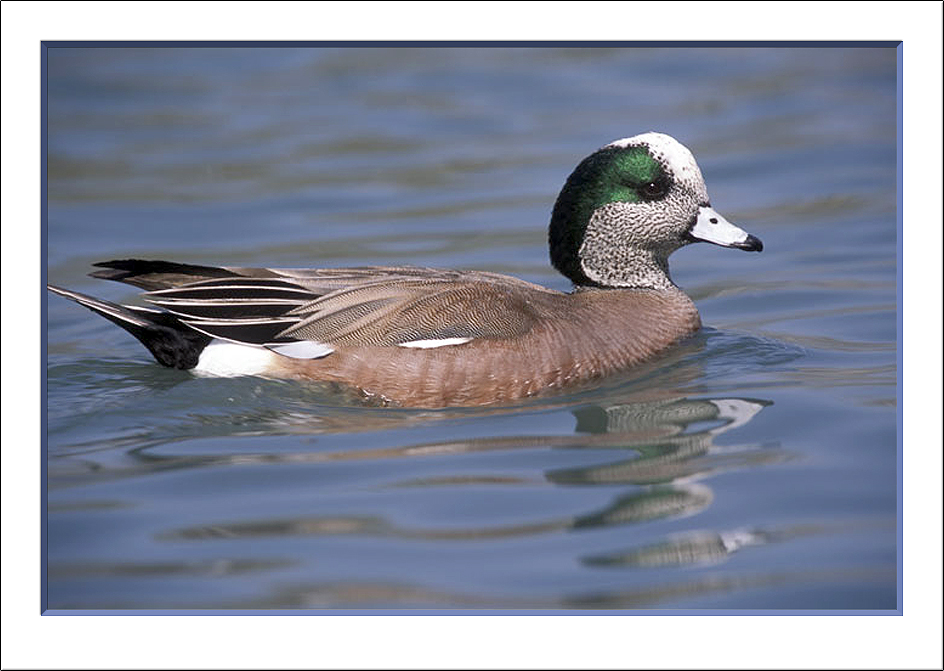
Two mallard ducks, appropriately named Jenny and Alfred, visit us for dinner every night. We eat strawbery rhubarb pie Alfred made and homemade goat cheese ravioli or a beet and potato salad and pour a cup full of chicken feed onto the end of the dock for them. They eat slowly and occasionally sip water from the lake.

The first morning of our residence at the house boat, three older, male bachelor ducks visited us hungry for food. We were happy to feed them, as an offering between new neighbors. Later in the day we would bake a cake to leave on Billie and Nancy and Ron's doorstep. One of the ducks, his green head ruffled from the night's escapades, was all too excited. Perhaps he needed some food to quell a nasty hangover. Or maybe he's just a gluttonous pig of a duck who would be happiest in a hot car on the shoulder of some highway eating McDonalds. Anyway, He lay down on his belly in the feed and with spread wings greedily ushered grain into his mouth. It was a delightful and hilarious, if not embarassing, for the duck, feeding frenzy to watch.

And then there was a muskrat. A nice little muskrat who was pushing a lily pad with his nose through the water, presumably, to the house he is building himself. The lily pad was large and covered the muskrat's small face, but he was earnest and pushed and swam and pushed and swam so determinedly that he ran smack right into the foundation of our neighbor's house boat, and kept going.

5/24/2006

Two Montana Barns


It was the way the light fell through the slats onto the barn's face, and the way this old ad hung so simply, like a canvas, as though it were part of an exhibition, "cour" tesy of someone else, not the people who live here, the Native Americans, the Flathead Indians.

5/17/2006

Sunsets and Streetscapes: Alki Beach, West Seattle


Sunsets and streetscapes in West Seattle...